TfL is moving forward the next phase of plans to reduce road danger for people walking and cycling on and near Battersea Bridge.
TfL accelerated plans to improve safety on the bridge following a passionate local campaign after the death of Jack Ryan on Battersea Bridge on 13 January 2021.
The first phase of work on the north side of the bridge was completed in November 2021 and included a new pedestrian crossing, wider pavements and a new lower speed limit of 20mph.
Following local engagement, last year TfL consulted on further proposals to make additional safety improvements to the rest of the junction.
Key results from the consultation showed that a majority of respondents (70%) expected the proposals would mean more people would choose to travel by cycling and more people would choose to walk (69%).
Half of respondents expected that more people would choose to use public transport.
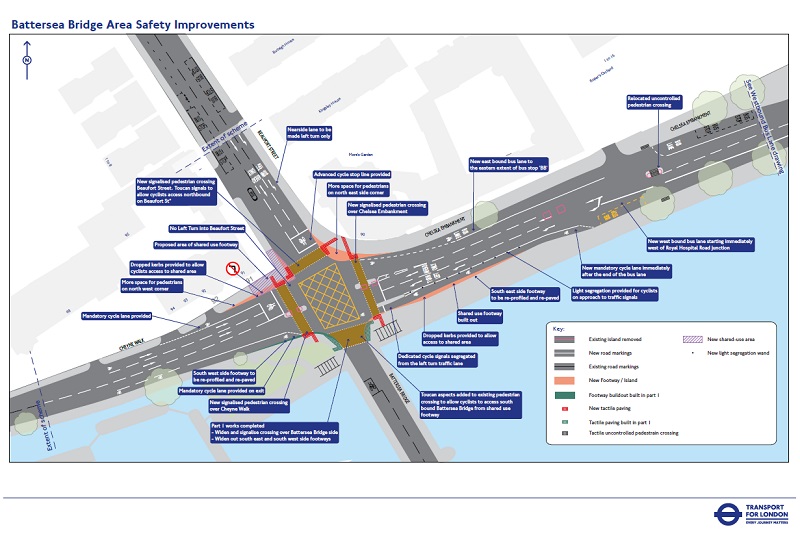
After fully considering the consultation responses, and further engagement with the Royal Borough of Kensington and Chelsea, TfL has decided to proceed with the following changes to the north end of the bridge:
- New, straight-across, push-button pedestrian crossings on Cheyne Walk, Chelsea Embankment and Beaufort Street
- Making improvements for cyclists at the junction by installing dedicated cycle signals and a section of segregated cycle track
- A new section of westbound bus lane from Royal Hospital Road to the bus stop at Beaufort Street to ensure bus journey times in the area are maintained
- Banning the left turn into Beaufort Street for a small number of vehicles, to reduce delays and wait times at the turning point, and to improve safety and eliminate the risk of left turning vehicles colliding with cyclists. Cyclists will still be able to access Beaufort Street via a shared use footway
TfL is also making changes to the southern end of the bridge, including:
- A new push-button pedestrian crossing on Battersea Bridge Road at Hester Road
- A bus gate, which would continue to improve bus journey times for buses travelling northwards
- A new pedestrian crossing at the Battersea Bridge Road / Battersea Church Road junction
- An extended bus lane from Banbury Street northwards on Battersea Bridge Road to improve bus journey times
- Reconfigured crossing points at the junction of Battersea Bridge Road with the Prince of Wales Drive, widening pavements, removing the existing traffic island and building two new pedestrian crossings
- Banning the right turn from Battersea Bridge Road into Parkgate Road and the left turn into the B305 to improve safety for people walking and cycling, including an “all green man” phase at the junction, and to help bus journey times
Penny Rees, TfL’s head of healthy streets investment, said: ”Every death and serious injury on London’s roads is unacceptable and we’re determined to make them safer for everyone. We are committed to Vision Zero, the mayor’s goal to eliminate death and serious injury from the transport network, and these changes will play a vital role in reducing danger at these key junctions.
“I’d like to thank everyone who took part in the consultation for their feedback, we’ll continue to work on our plans to improve safety in the area.”
Chelsea resident Rob McGibbon started the safety campaign to improve safety at the junction after witnessing the aftermath of the Jack Ryan tragedy.
He said: “I am delighted that the Phase 2 works have been agreed and will go ahead. It will make a huge difference to thousands of pedestrians and cyclists that use this area.
“I would like to thank TfL and its officers for being so consultative throughout this process and for moving quickly to make this junction safer.
“The support for the campaign – from the public, the Royal Borough of Kensington & Chelsea and from local residents’ associations – has been extraordinary and it goes to prove that change really can happen when people work positively together.”
TfL plans to begin work on the Battersea Bridge safety improvements this winter.
22 June 2023